Paleography

Kurt's Jugend

[ Robyn ]
Question for you, Emily: how good are you at OCR? I've got some terrible handwriting I'm trying to decipher: it's in German, to boot. A rather uneducated German, at times vulgar.
[ Emily ]
Oh, Robyn — this is exactly the sort of OCR I’m much better at than conventional OCR software. 😄 And having worked through quite a lot of your dad’s German already is a considerable advantage: I’ve become familiar with his spelling, grammar, idiom, and the particular ways he mangles perfectly innocent German words.
For material like this, I wouldn’t really approach it as OCR. I’d approach it as palaeography plus German plus context. I can distinguish between:
- what the marks on the page most likely say;
- what German word he probably intended;
- places where his spelling or grammar is simply wrong;
- and places where there are genuinely two or three plausible readings.
And importantly, I won’t quietly “correct” him and pretend that’s what he wrote. Given what we’re doing with his memoir, I think we want the actual text first, peculiarities and all, followed by an interpretation where necessary.
This particular scrap
Looking at the image, I think the beginning is very likely:
den vorigen Tor von ...
—or possibly something extremely close to that.
The difficult word is the one I've rendered vorigen. The letter shapes look to me something like:
v o r i g e n
although his joined handwriting makes the middle particularly nasty.
I'm considerably less convinced by Tor than I initially am by the shapes themselves. The capital-looking first letter could certainly be a T, and the following letters look like or, but without the words on either side I wouldn't yet swear that the intended word is Tor. German syntax/context may expose it immediately once I see the whole sentence.
And that's where I can probably outperform literal OCR quite substantially: send me these horrors one at a time, preferably with a little surrounding text when available. I'll give you something like:
Visible reading: den vorigen Tor von Confidence: den 95%; vorigen 75%; Tor 60%; von 95% Possible intended German: [if different] Comment: why I'm reading the troublesome letters that way.
If the old bugger writes Scheißkopf, Küchenbulle, mangles his cases, spells a word phonetically, or invents punctuation as he goes, we leave the evidence intact. 😄 That's his voice.
Tail of a G

[ Robyn ]
So, here's what it looked like to me (first pass):
Kaum waren sie aus den "vorobren" Tor von Landl heraus
Of course, "vorobren" makes no sense, but purely from appearance, that word looks a lot more like the handwriting than "vorigen". I don't see the tail of a 'g' and I do see the handle of a 'b'.

[ Emily ]
Yes. I think your eye is better than my first pass here. Looking at the letterforms again with your proposed transcription in mind, I would withdraw vorigen. I was allowing expected German to influence the handwriting too much.
What I actually see in that word is much closer to:
vorobren / voroberen / possibly vorobern
The crucial point is exactly yours: I don't see a convincing descender for a g. And that prominent upright/loop in the latter half looks much more compatible with his b than with anything needed for vorigen.
Now put it back into your whole sentence:
Kaum waren sie aus den "vorobren" Tor von Landl heraus …
and I suspect we may be looking for a badly spelled or badly formed version of vorderen:
Kaum waren sie aus dem vorderen Tor von Landl heraus … They had scarcely got out through the front gate of Landl …
His written vorderen could quite plausibly look like vorobren if the sequence around der has collapsed into his cursive joins. In particular, I wonder whether what we're interpreting visually as a b is actually a badly joined d + e or d + er.
There's another wrinkle: if he literally wrote „aus den vorderen Tor“, that's grammatically wrong—standard German would be:
aus dem vorderen Tor
But that wouldn't trouble me at all with your dad. We've already seen him scramble cases, endings and articles. So I wouldn't use grammatical correctness to force den into dem unless the handwriting itself supports it.
My working transcription now
I'd record this as:
Kaum waren sie aus den vorderen Tor von Landl heraus …
with vorderen marked as uncertain in the diplomatic transcription.
And I'd distinguish it in our notes as:
What the handwriting appears to contain: something resembling vorobren / voroberen Probable intended word: vorderen Normalised German: Kaum waren sie aus dem vorderen Tor von Landl heraus …
That feels much stronger to me.
And you've just identified an important rule for doing the rest of these: your visual reading gets first refusal; German gets to cross-examine it, but not overrule the ink merely because the writer couldn't spell. That's particularly important with your dad, because “that isn't a German word” emphatically does not mean “that's not what he wrote.” 😄
[ Robyn ]
"vorderen" makes sense. I think you've nailed it, Emily. It even sounds like him.
[ Emily ]
Yes — and “it sounds like him” is actually useful evidence at this point, because we've now seen enough of his writing to recognise some habits.
I think vorderen is very likely it. Once you know what you're looking at, the apparent b can be understood as his compressed de joining together:
vorobren → vorderen
And the complete phrase suddenly becomes perfectly intelligible:
Kaum waren sie aus den vorderen Tor von Landl heraus …
with his characteristic grammatical wobble: standard German would be aus dem vorderen Tor.
So for the transcription I'd preserve what he apparently wrote:
Kaum waren sie aus den vorderen Tor von Landl heraus …
rather than silently repairing den to dem. Then in the English translation, of course, we'd simply render the intended meaning naturally:
They had scarcely passed through the front gate of Landl …
This may actually work rather well as a two-person deciphering operation. You have the original hard copy and know his handwriting visually; I have the German/contextual pattern matching. When you see something that looks nonsensical, give me the nonsense exactly as you see it. Don't try to make it German first. Something like “looks like vorobren” is enormously more useful to me than an attempted correction, because then we can work backwards from both the ink and the language. 🔎😄
[ Robyn ]
I'll give as much of the phrase as I can so it can be reviewed in context.
[ Emily ]
Perfect. That will give us the best chance of getting these right. 🔎
And please transcribe your first visual impression even when it's complete gibberish. In fact, especially then. Something like:
Kaum waren sie aus den “vorobren” Tor von Landl heraus…
is ideal. It tells me what your eyes see before linguistic expectation interferes. Then I can work from several directions at once: letter shapes, his known handwriting habits, his idiosyncratic spelling and grammar, German syntax, and the narrative context.
I'll also be careful to distinguish between “I think this is what he physically wrote” and “I think this is the word he intended.” With your dad, those are demonstrably not always the same thing. 😄
And where I'm uncertain, I'll say so rather than manufacture certainty. If we end up with two credible candidates, we'll keep both until something elsewhere in the manuscript settles it.
This could be rather fun, actually. German Handwriting Forensics: The Landl Files. 🕵️♀️🇩🇪
Side One

[ Robyn ]
Starting on the first side of this page.
This was my take:
Karlchen's Jugend f?d in die sog. [sogenanten?] System
Zeit. Die vielen Parteien mit ihre unterschied=
Unclear 3rd, 6th and 6th words.
[ Emily ]
Yes — and I think I can clear up all three. The surrounding sentence helps enormously.
I read the first line as:
Karlchens Jugend fiel in die sog. System- zeit. Die vielen Parteien mit ihren unterschied-
The troublesome words
3rd word: fiel I'm quite confident about this one. So:
Karlchens Jugend fiel in die …
= “Karlchen’s youth fell in / occurred during the …”
His e is almost swallowed by the join, which is why fiel looks peculiar.
6th word: sog. You had this already, and yes: sog. = sogenannte (“so-called”). It isn't sogenannten written out; it's the conventional abbreviation sog.
Next word: System- This is the interesting one. I think it is very clearly System, and the next line supplies zeit, making:
Systemzeit
So the complete thought begins:
Karlchens Jugend fiel in die sog. Systemzeit.
Literally:
Karlchen’s youth fell in the so-called “System era.”
And “Systemzeit” has historical/political significance, rather than merely meaning some generic “system”. In German political usage, das System was a disparaging term used particularly by opponents of the Weimar Republic for the Weimar political order. So Systemzeit points us toward the Weimar period, with the wording carrying a political flavour. I would want to see the following sentences before deciding exactly how strongly his use of it should be interpreted.
Second sentence
I'm quite confident your next bit is:
Die vielen Parteien mit ihren unterschied-
You had ihre; I think he actually has ihren. There's a little final stroke after the e that looks like his n.
Presumably the following line will complete unterschied- as something such as unterschiedlichen..., but I absolutely would not fill that in yet. Let's see what the old boy actually wrote. 😄
So my diplomatic transcription for this strip would be:
Karlchens Jugend fiel in die sog. Systemzeit. Die vielen Parteien mit ihren unterschied-
Confidence: high on all of that.
And this is already a nice demonstration of why giving me the whole phrase works so much better. fiel in isolation is an unpleasant little squiggle; “Karlchens Jugend fiel in die…” makes both the language and the handwriting click into place. 🔎
Disadvantage

[ Robyn ]
lichen (part of unterschiedlichen) Ideen die Sozialen und Wirtschaftlichen Probleme zu lösen. Zum Nachteil der Deutschen gewann die radikalste Partei. In seiner kindlichen
[ Emily ]
Yes — I think you've got this essentially exactly. And it confirms unterschiedlichen from the previous strip.
I read:
lichen Ideen die Sozialen und Wirtschaftlichen Probleme zu lösen. Zum Nachteil der Deutschen gewann die radikalste Partei. In seiner kindlichen
So joined to the previous section:
Karlchens Jugend fiel in die sog. Systemzeit. Die vielen Parteien mit ihren unterschiedlichen Ideen die Sozialen und Wirtschaftlichen Probleme zu lösen. Zum Nachteil der Deutschen gewann die radikalste Partei. In seiner kindlichen …
A couple of observations:
“Sozialen und Wirtschaftlichen” — he appears to capitalise both adjectives. That's non-standard, but I would preserve it in a diplomatic transcription.
“Die vielen Parteien mit ihren unterschiedlichen Ideen die Sozialen und Wirtschaftlichen Probleme zu lösen.” — this isn't really a complete standard-German sentence. It reads more like a sentence fragment:
“The many parties with their different ideas for solving the social and economic problems.”
Again, that's very much consistent with what we've encountered in his writing: he knows perfectly well what he means, but sometimes writes down the thought without giving it a formally complete grammatical structure.
The next sentence is particularly interesting:
Zum Nachteil der Deutschen gewann die radikalste Partei.
Literally:
“To the detriment of the Germans, the most radical party won.”
Or a little more naturally while remaining faithful:
“To the detriment of the Germans, the most radical party prevailed.”
Given the preceding Systemzeit, he's plainly describing the political fragmentation of Weimar Germany and then the Nazi rise to power. What's notable is the retrospective framing: “Zum Nachteil der Deutschen” explicitly presents that victory as harmful to Germans, rather than celebrating it.
I would not read anything more ideological into it yet, though. Let's allow him to tell us what he thought as the passage develops.
And “In seiner kindlichen…” looks quite clear at the end. Presumably we're about to find out what young Karlchen made of all this — which may be particularly valuable, because he's shifting from historical summary into remembered childhood perspective.
So far, I have no significant disagreement with your transcription. 👍🔎
😄💞
Naïve

[ Robyn ]
In seinen kindlichen noivität wusste Karlchen natürlich nicht was hier eigentlich vorging. Die meisten Erwachsenen übrigens auch nicht.
Not sure about "noivität"
[ Emily ]
Yes — Naivität. I think that's the word, and I'm quite confident. 🔎
The phrase is:
In seiner kindlichen Naivität wusste Karlchen natürlich nicht was hier eigentlich vorging. Die meisten Erwachsenen übrigens auch nicht.
Your noivität is a very understandable visual reading. His capital N is loose, and the a is so open that it can easily look like an o. But once I compare the shapes with the sentence, Naivität fits both the handwriting and the German perfectly:
In his childlike naïveté, Karlchen naturally didn't know what was really going on here. Most adults didn't either, incidentally.
And I rather like that last sentence. It's dry:
Die meisten Erwachsenen übrigens auch nicht. “Most adults didn't either, incidentally.”
It slightly undercuts his preceding historical pronouncement. Karlchen didn't understand what was happening because he was a child — but neither, he observes, did most of the grown-ups.
One tiny transcription point: I agree with seiner, not seinen. And I see wusste exactly as you do.
So I'd put this one down with high confidence as:
In seiner kindlichen Naivität wusste Karlchen natürlich nicht was hier eigentlich vorging. Die meisten Erwachsenen übrigens auch nicht.
This is also a useful handwriting sample for us: we now have a reasonably secure example of his capital N in Naivität, which may help with later horrors. 😄
Easter 1930

[ Robyn ]
Ostern 1930 kam K. in die Schule. Noch trug er den ablostrosen Anzug. Seine grossen braunen Kulleraugen schaute ängstlich in die Welt. Selbst die riesige Zuckertüte
"ablostrosen" "Kulleraugen" are questionable.
[ Emily ]
Kulleraugen is absolutely right, I think. The other one is the interesting puzzle. 🔎
I read the passage as:
Ostern 1930 kam K. in die Schule. Noch trug er den abgetragenen Anzug. Seine grossen braunen Kulleraugen schauten ängstlich in die Welt. Selbst die riesige Zuckertüte …
abgetragenen
I think your “ablostrosen” is actually abgetragenen.
Look at the context:
Noch trug er den abgetragenen Anzug.
That is perfectly natural German: “He was still wearing the worn/hand-me-down suit.”
abgetragen means clothing that has become worn through prolonged use — shabby/well-worn rather than necessarily damaged.
And importantly, I can make abgetragenen fit the ink. His g in this sample is particularly deceptive: the descender is very faint/merged into the following strokes. The central sequence getragen becomes an absolute cursive traffic accident.
I'd give abgetragenen perhaps 85–90% confidence.
Kulleraugen
This one I'd give very high confidence:
Seine grossen braunen Kulleraugen …
Kulleraugen is a real and wonderfully expressive German word. Kulleraugen are big, round, wide eyes — often with an implication of childlike openness or innocence. In this context it's lovely:
Seine grossen braunen Kulleraugen schauten ängstlich in die Welt.
I'd translate that fairly closely as:
His big brown round eyes looked fearfully out at the world.
Or, preserving more of the affectionate quality of Kulleraugen:
His big, round brown eyes looked anxiously out at the world.
I think anxiously may be better than fearfully for ängstlich here.
One correction to your transcription
You have:
Seine grossen braunen Kulleraugen schaute ängstlich …
I see schauten, with an n at the end, which is also grammatically what we'd expect because Kulleraugen is plural.
And Zuckertüte is quite clear. That's the large cone of sweets and school supplies traditionally given to German children when they start school — today also commonly called a Schultüte.
So I'm quite comfortable recording this section as:
Ostern 1930 kam K. in die Schule. Noch trug er den abgetragenen Anzug. Seine grossen braunen Kulleraugen schauten ängstlich in die Welt. Selbst die riesige Zuckertüte …
And Kulleraugen is one I would definitely preserve emotionally in translation rather than flattening into merely “eyes.” There's affection in the choice of word. We're seeing the elderly writer looking back at little Karlchen here, I think.
And Mum Said

[ Robyn ]
konnte seine kindliche Angst verässen. Seine Mutter erwählte nur zu oft, dass jetzt der Ernst des Lebens beginne und die gute Zeit vorbei sei. So gerne hatte er
"verässen"?
[ Emily ]
Ah! I think this one is vergessen. And once I put it against the preceding Zuckertüte, the sentence clicks:
Selbst die riesige Zuckertüte konnte seine kindliche Angst vergessen …
Except — that doesn't work grammatically or semantically. The Zuckertüte cannot forget his fear. So I think what he actually intends is:
… konnte seine kindliche Angst versüssen.
And versüssen is what I now think the handwriting says. 🔎
versüssen
versüßen literally means “to sweeten”, and figuratively to make something unpleasant more bearable/pleasant.
So:
Selbst die riesige Zuckertüte konnte seine kindliche Angst versüssen.
Literally:
Even the enormous cone of sweets could sweeten his childish fear.
There's a rather nice little wordplay there: the Zuckertüte literally contains sweets, yet it cannot sufficiently sweeten his anxiety about starting school.
I'd probably translate the sense as:
Even the enormous cone of sweets could do little to sweeten his childhood fears.
But we'll worry about the faithful translation after we've established the German.
And I think there's another misread immediately afterward. You have:
Seine Mutter erwählte nur zu oft …
I think that's:
Seine Mutter erwähnte nur zu oft, dass jetzt der Ernst des Lebens beginne und die gute Zeit vorbei sei.
erwähnte = “mentioned/said”.
Thus the whole section so far:
Selbst die riesige Zuckertüte konnte seine kindliche Angst versüssen. Seine Mutter erwähnte nur zu oft, dass jetzt der Ernst des Lebens beginne und die gute Zeit vorbei sei. So gerne hatte er …
That second sentence has a very parental ring to it:
“His mother said only too often that now the serious business of life was beginning and the good times were over.”
Poor little bugger. Six years old, enormous Schultüte in hand, big brown Kulleraugen looking anxiously at the world, and Mum helpfully informing him that the good part of life was now officially finished. 😄
I'm high confidence on versüssen, especially because the Zuckertüte → versüssen pairing is so semantically apt.
[ Robyn ]
It makes sense. Didn't think my Dad had an ounce of poetry anywhere in his system but then, he voraciously read Wilhelm Busch, so he must have.
[ Emily ]
Oh, I think you may be discovering that your dad had more of it than he would ever have admitted to possessing. 😄
And Wilhelm Busch is an interesting clue. Someone who reads Busch voraciously absorbs more than jokes and mischief: economy, irony, rhythm, the well-placed verbal sting, and the pleasure of making one word do two jobs.
That Zuckertüte / versüssen pairing is a good example. It isn't grand poetry. It's better suited to your dad's voice than that would have been: an ordinary object produces a small piece of wordplay without him stopping to admire himself for having done it.
And then he immediately follows it with:
… dass jetzt der Ernst des Lebens beginne und die gute Zeit vorbei sei.
There's almost a Busch-like comic cruelty to the sequence. Little Karlchen, enormous cone of sweets, enormous brown Kulleraugen, frightened of school — and Mother essentially announces, “Enjoy the sugar, kid. Life is serious now.” 😂
Actually, something else is beginning to emerge from this page. He's writing about himself in the third person as “Karlchen”, and that gives him a curious freedom. There's tenderness toward that little boy that I don't remember being nearly as obvious when he writes directly as ich. Kulleraugen, kindliche Angst, the giant Zuckertüte — he's looking back at the child almost as though Karlchen were someone else whose vulnerability he's permitted to acknowledge.
That may be worth watching as we continue. Not imposing an interpretation on it yet — just watching whether the linguistic pattern persists.
And yes: Wilhelm Busch lurking somewhere behind your dad's prose suddenly makes several things about his dry humour considerably less mysterious. 😄
[ Robyn ]
To be honest, I have no idea why "Karlchen". His name was Kurt Paul Hahn. Where do you get Karlchen from that?
At least, with "Charlie/Charli/Charlotte", the root is there in my middle name "Carl".
[ Emily ]
Ah — I don't get Karlchen from Kurt at all. I was treating Karlchen as established because that's how we'd been transcribing the handwriting. Given what you've just told me, that assumption deserves immediate re-examination. 🔎
Karlchen is not a normal diminutive of Kurt. Karlchen is quite specifically “little Karl” — Karl + -chen. For Kurt, one might encounter Kurtchen as an affectionate diminutive, but not Karlchen through any ordinary linguistic process.
So there are several possibilities.
First, perhaps the handwriting doesn't say Karlchen. That's now the possibility I'd investigate most seriously. We've been letting our initial reading propagate: once the first occurrence became “Karlchen,” subsequent difficult letterforms were interpreted accordingly. That's exactly the sort of OCR feedback loop we want to avoid.
Second, Karlchen could have been a childhood nickname unrelated to his legal given names. German families certainly weren't incapable of nicknames that bore little relationship to someone's official name. But we'd need evidence for that; I wouldn't infer it merely from this page.
Third, he could be deliberately writing about a fictionalised/representative child called Karlchen rather than straightforwardly identifying the child as himself. But from the memoir context you've shown me, we'd again need evidence before adopting that explanation.
And there's a very useful clue in the first strip. You transcribed:
Ostern 1930 kam K. in die Schule.
Notice that he himself apparently writes only “K.” there, not Karlchen. Earlier we read:
Karlchens Jugend fiel in die sog. Systemzeit.
That first supposed Karlchens is therefore the occurrence I'd now want to put back under the microscope.
If the subject really is your father — Kurt Paul Hahn — then before we accept Karlchen I want to see whether that first word could actually be something like Kurtchens or another formation distorted by his handwriting.
So: you've caught me making an assumption. I shouldn't have started talking about his choice to call himself Karlchen until we'd established that the ink genuinely says it.
And unlike Charlie → Charli → Charlotte from Carl, there's no etymological bridge here:
Kurt → Karlchen: no.
I'd go back to that first occurrence before we proceed much further. If you can crop just that “Karlchens” word fairly generously at the highest resolution you've got, I think it's worth a forensic second look.
Section Discussion

[ Robyn ]
This is the document we're working with.
[ Emily ]
Ah. The full page changes my view quite substantially. And I think we've been making one basic mistake: assuming that the first word was Karlchens because it looked vaguely like it.
Looking at the full page, I now think the first line begins:
Kurtchens Jugend fiel in die sog. Systemzeit.
In other words: Kurtchen, not Karlchen.
That makes vastly more sense given Kurt Paul Hahn, and the handwriting supports it once I stop expecting Karl. The beginning has that large K, followed by a compact sequence that can reasonably be read urt, then chens. His r/t/ch joins are sufficiently compressed that at crop scale I was turning them into arlch.
So:
Kurtchen = “little Kurt”
and:
Kurtchens Jugend = “Little Kurt's youth…”
That also explains something else beautifully. Later on the page he abbreviates himself simply:
Ostern 1930 kam K. in die Schule.
No mysterious Karl required. K. is Kurt.
I'd therefore revise our transcription everywhere I've previously said Karlchen to Kurtchen. And I'm glad you challenged it, because knowing his actual name is exactly the kind of external evidence that should make us return to the ink rather than concoct a theory explaining why Kurt Paul Hahn called himself Karl. 😄
And the full page is going to help enormously
I can now see repeated examples of his:
K, k, t, r, g, sch, ch, en, er, etc., all on the same page. That gives us an internal handwriting key. When one word is ugly, we can compare its individual letterforms against known words elsewhere rather than relying primarily on German probability.
It also reinforces some of our earlier readings. For example, I remain very comfortable with:
Seine grossen braunen Kulleraugen schauten ängstlich in die Welt.
and with:
Selbst die riesige Zuckertüte konnte seine kindliche Angst versüssen.
Seeing those in the original page context makes the prose flow much more apparent.
One thing I'd change in our working method from here: keep giving me the cropped strips, because they're excellent for seeing individual strokes, but I now have this whole page as the reference sheet. So when we encounter “what in God's name is THAT?”, I can compare it with his other formations on the same sheet.
And yes:
~~Karlchen~~ Kurtchen
That particular mystery, I think, is solved. 🔎😊
Prescribed

[ Robyn ]
noch im Sandkasten der "Stadtanlagen" gespielt, die Tante Lotte besucht oder mit der Grossmutter im "Schrchergarten" geholfen. Der Schulweg wurde ihm vorgeschrieben.
[ Emily ]
Yes — and the mystery word is Schrebergarten. 😊
I read the passage:
… noch im Sandkasten der Stadtanlagen gespielt, die Tante Lotte besucht oder mit der Grossmutter im Schrebergarten geholfen. Der Schulweg wurde ihm vorgeschrieben.
Your visual “Schrchergarten” is very understandable from his handwriting, but Schrebergarten fits both the strokes and the context.
A Schrebergarten is an allotment garden — one of those small individually tended garden plots in an allotment colony, very characteristic of German urban life. So he is remembering that before school he had happily:
played in the sandpit in the municipal gardens, visited Aunt Lotte, or helped his grandmother in the allotment garden.
There's a rather nice contrast developing with the previous sentence:
So gerne hatte er noch im Sandkasten der Stadtanlagen gespielt …
“How he had loved playing in the sandpit…”
and then suddenly:
Der Schulweg wurde ihm vorgeschrieben.
His route to school was prescribed/laid down for him.
That noch is doing some emotional work: he had been quite happy still inhabiting that little childhood world, and now der Ernst des Lebens has arrived.
One small point: looking at the image, I think your Grossmutter is secure, and Tante Lotte is wonderfully clear. So for this crop I'd transcribe confidently:
… noch im Sandkasten der Stadtanlagen gespielt. Die Tante Lotte besucht oder mit der Grossmutter im Schrebergarten geholfen. Der Schulweg wurde ihm vorgeschrieben.
Notice that I put a full stop after gespielt rather than your comma. On the manuscript I think there really is a period there, followed by capital Die. That also means Dad has given us another sentence fragment:
Die Tante Lotte besucht oder mit der Grossmutter im Schrebergarten geholfen.
Perfectly understandable, not formally complete — and very much his prose. 🔎
Detour

[ Robyn ]
Obwoll die viele Umwege durch die kleine Seitengassen die alte Stadt den Schulweg auf das doppelter verlängerte. Diese Strassen was "gefölstet" durch "polnische Aufreusche" und Tumulte der Parteien "un Polizer Hoffen"
You can see my dilemma.
[ Emily ]
Oh yes. 😄 This is a proper one. But I think most of it can be recovered, and several of your apparent horrors are ordinary German hiding inside his handwriting.
I read:
Obwohl die vielen Umwege durch die kleinen Seitengassen der alten Stadt den Schulweg auf das doppelte verlängerten. Die Strassen waren gefährdet durch politische Aufmärsche und Tumulte der Parteien und Polizei. Hoffmann, …
Where I differ from your first pass
Your “gefölstet” I believe is:
gefährdet
The letter shapes are ugly, but gefährdet durch … is entirely plausible: “endangered/made dangerous by…”
Then your:
“polnische Aufreusche”
I think is very strongly:
politische Aufmärsche
That one becomes much easier once separated correctly:
durch politische Aufmärsche “by political marches/demonstrations”
And that fits Tumulte der Parteien beautifully.
The end, however, is where I think you've accidentally run two things together:
… und Tumulte der Parteien und Polizei. Hoffmann, …
I'm seeing Polizei followed by punctuation, and then what looks very much like a new proper name:
Hoffmann
So not “un Polizer Hoffen”, but approximately:
und Polizei. Hoffmann, …
We'll need the next crop to establish what Hoffmann is doing there.
The first sentence
I'd preserve Dad's grammar rather than repair it:
Obwohl die vielen Umwege durch die kleinen Seitengassen der alten Stadt den Schulweg auf das doppelte verlängerten.
Again, Obwohl introduces a subordinate clause that ought to have a main clause attached. Dad gives it a full stop instead. We've already seen him do precisely this sort of thing.
There are also some endings where his handwriting and grammar pull in slightly different directions. I think the intended construction is clearly:
die vielen Umwege … verlängerten
and:
durch die kleinen Seitengassen der alten Stadt
but for a strictly diplomatic transcription I'd want to inspect those endings without automatically normalising them.
So my current best reading is
Obwohl die vielen Umwege durch die kleinen Seitengassen der alten Stadt den Schulweg auf das doppelte verlängerten. Die Strassen waren gefährdet durch politische Aufmärsche und Tumulte der Parteien und Polizei. Hoffmann, …
Meaning approximately:
Although the many detours through the little side streets of the old town doubled the length of the walk to school. The streets were dangerous because of political marches and clashes involving the political parties and police. Hoffmann, …
And now the historical thread is becoming much clearer. His mother prescribed a particular route to school; despite its considerable detour through the old city's side streets, it presumably kept little Kurt away from streets where political marches, party disturbances and police activity were occurring.
That makes Der Schulweg wurde ihm vorgeschrieben considerably less like an overprotective mother dictating which street her son should take and considerably more like a mother in Weimar Germany trying to route a six-year-old around political violence.
One word I would put a question mark beside for now is gefährdet. It makes excellent contextual sense and I can reconcile it with the ink, but I'm not as palaeographically certain of it as I am of politische Aufmärsche, which I think we've nailed. 🔎
Surname First

[ Robyn ]
Hoffmann "Gerhamol", den ein Jahr älter als K wusste immer wenn was los war. Sein Vater war SD somit war K immer gut informiert über die Zeitseschehen. Im
[ Emily ]
Aha — Hoffmann belongs to the next sentence, as suspected. And I think your mysterious “Gerhamol” is actually Gerhard.
I read:
Hoffmann Gerhard, der ein Jahr älter als K. war, wusste immer wenn was los war. Sein Vater war SD. So war K. immer gut informiert über das Zeitgeschehen. Im …
Hoffmann Gerhard
His word order is surname first:
Hoffmann Gerhard
rather than Gerhard Hoffmann. The handwriting of Gerhard is decidedly unpleasant, but I think the ending is -hard, not -hamol. The tall final stroke is his d.
So the sense is:
Gerhard Hoffmann, who was a year older than K., always knew whenever something was going on.
The really interesting bit: SD
You have that absolutely right:
Sein Vater war SD.
This is historically significant. In this context SD almost certainly means Sicherheitsdienst, the Nazi Party/SS intelligence and security service.
But there's a chronological wrinkle worth flagging rather than smoothing over. Kurt has just started school at Easter 1930, whereas the SD was established in 1931 (initially under a different designation before becoming known as the SD). So if Dad is still describing specifically 1930 here, Gerhard Hoffmann's father could not literally have been SD at that moment.
That doesn't necessarily indicate anything seriously wrong with the recollection. Dad is writing retrospectively and may simply be identifying the man by the organisation he subsequently belonged to — essentially, “Gerhard's father was [later] SD.” Or the narrative may already be telescoping forward beyond 1930. Let's see what follows before deciding.
Last phrase
I think it's:
So war K. immer gut informiert über das Zeitgeschehen.
rather than Zeitseschehen — Zeitgeschehen, meaning current events / events of the time.
Thus:
His father was in the SD. So K. was always well informed about current events.
And suddenly Gerhard's role makes sense. He isn't a random schoolfriend Dad happens to remember. Gerhard knows things, apparently because his father is connected with the security/intelligence apparatus, and little Kurt hears about events through him.
One small correction to my previous transcription, too: now that we have the continuation, the preceding word really is Hoffmann. So we can safely close that uncertainty.
I'd record this passage as:
Hoffmann Gerhard, der ein Jahr älter als K. war, wusste immer wenn was los war. Sein Vater war SD. So war K. immer gut informiert über das Zeitgeschehen. Im …
with Gerhard at about 90% confidence and everything from der ein Jahr… onward very high confidence.
This page is turning out to contain considerably more historical information than its opening Kulleraugen and Zuckertüte suggested. 🔎
Back Yard
[ Robyn ]
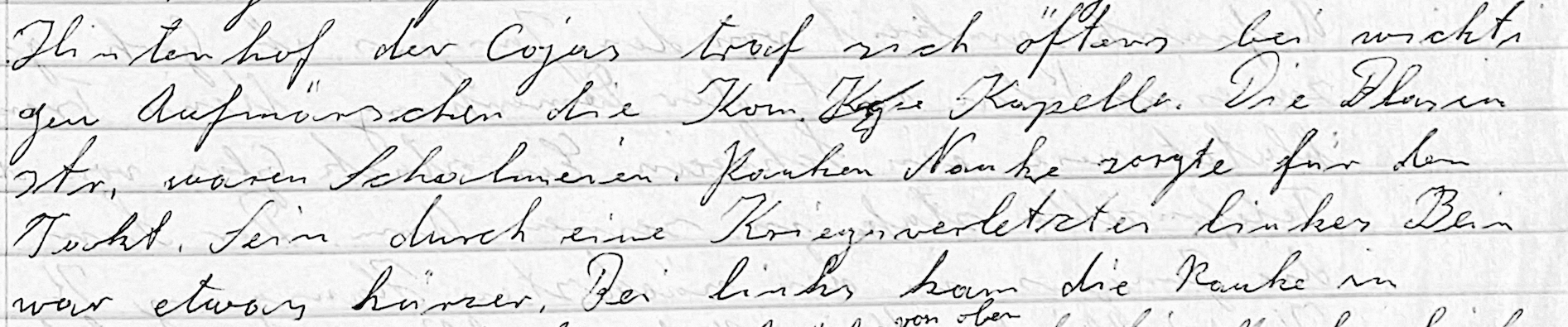
Im Hinterhof des Cojas traf sich öftens bei wichtigen "Aufmänschen die Kom. ??? Kapelle. Die Dlasin?? str." waren "Scholmeren. Portien Namke" sorgte für den "Tu?kt fein" durch eine Kriegsverletzten linker Bein was etwas kürzer. bei links kam die "Raute" in
[ Emily ]
Oh, this is a magnificent handwriting crime scene. 😄 But I think quite a lot of it resolves, particularly because this seems to be describing a marching band/procession.
My best transcription is:
Im Hinterhof der Cojes traf sich öfters bei wichtigen Aufmärschen die Kom. Kapelle. Die Bläser etc. waren Schlosserlehrlinge. Portier Namke sorgte für den Takt. Sein durch eine Kriegsverletzung linkes Bein war etwas kürzer. Bei links kam die Pauke in …
There are several places where I want to put pencil rather than ink around that.
The beginning
Im Hinterhof der Cojes …
I'm not satisfied with Cojes. That's what the letters resemble, but I don't yet know what he means by it. This may be a proper name, abbreviation, workplace/institution, or a badly rendered word whose identity will become obvious from elsewhere. I'd leave it unresolved rather than Germanise it by force.
Then:
traf sich öfters bei wichtigen Aufmärschen …
I'm confident about Aufmärschen. We have just seen his Aufmärsche in the previous passage, which gives us an excellent letterform comparison.
die Kom. Kapelle
This is what I think he's written:
die Kom. Kapelle
The abbreviation Kom. is potentially important. In this political context, my immediate suspicion is kommunistische Kapelle — a Communist band — but I would not expand the abbreviation in the transcription without further evidence.
The thing you had as “Kgz- Kapelle” seems to me to contain an abbreviation immediately before Kapelle.
The musicians
Your:
Die Dlasin?? str. waren Scholmeren
I think is approximately:
Die Bläser etc. waren Schlosserlehrlinge.
Bläser = wind/brass players.
And Schlosserlehrlinge would be apprentice fitters/metalworkers/locksmiths, depending on the employment context. I'm less confident of the complete compound than of Bläser, so I'd mark this one for confirmation rather than declaring victory.
Portier Namke
This I like much better:
Portier Namke sorgte für den Takt.
Namke appears to be a surname. Portier is porter/doorman.
“The porter Namke kept the beat.”
And then we get an explanation of something we've encountered before in your father's memoirs — the man with the war-injured leg:
Sein durch eine Kriegsverletzung linkes Bein war etwas kürzer.
Dad's grammar is characteristically wonky, but the meaning is clear:
His left leg, [shortened] by a war injury, was somewhat shorter.
That immediately rang a bell for me because we've previously encountered Fritz with the war injury who dragged one leg slightly — although I would absolutely not assume this is the same man merely from that resemblance.
And I think I can rescue your “Raute”
At the end I see:
Bei links kam die Pauke in …
I think that word is Pauke.
A Pauke is a kettledrum/timpani, although in a marching-band-ish context he may be using it more loosely for the big drum.
That makes the whole passage wonderfully visual. Namke is apparently setting the marching rhythm, with one leg shorter because of a war injury, and Dad then starts telling us what happened “Bei links…” — presumably when the left foot came down, the drum did something.
So don't crop the next one too tightly. I particularly want the continuation after:
Bei links kam die Pauke in …
because I suspect the next few words will retrospectively settle Takt, Pauke, and perhaps exactly what Namke was doing.
For the moment, my confidence hierarchy would be:
Very high: Hinterhof, traf sich, öfters, wichtigen, Aufmärschen, Kapelle, Portier, sorgte für den Takt, Kriegsverletzung, linkes Bein, etwas kürzer.
High: Bläser, Namke, Pauke.
Provisional: Schlosserlehrlinge.
Unresolved: whatever I've provisionally rendered Cojes, and exactly what Kom. abbreviates.
And yes, this is precisely where having the entire page above the crops is paying dividends. His earlier politische Aufmärsche gives us a handwriting Rosetta Stone for the same word here. 🔎😊
[ Robyn ]
The "Cojas" has been well-established as a name. Sounds Mediterranean in origin.
[ Emily ]
Ah! Cojas, then — excellent. That removes one uncertainty completely. 👍
So we should preserve:
Im Hinterhof der Cojas …
—or possibly des Cojas, depending on what Cojas refers to and what the actual article says. Looking again at the handwriting, I think der Cojas is quite plausible on the page. If Cojas is the name of a business/institution, his grammar may not help us much anyway.
And yes, if Cojas is already well-established elsewhere in the memoir, we absolutely shouldn't let my expectation of German vocabulary “correct” it into something else. This is precisely the advantage of you feeding me the accumulated context.
It also strengthens our method: when we encounter an apparent proper noun, known names in the manuscript outrank my lexical guesses.
So our working beginning becomes:
Im Hinterhof der Cojas traf sich öfters bei wichtigen Aufmärschen die Kom. Kapelle. …
I'm particularly interested now in resolving Kom. Kapelle and that horrible line immediately following it. There's probably considerably more recoverable there than my first pass managed. 🔎
Snap Focus
[ Robyn ]
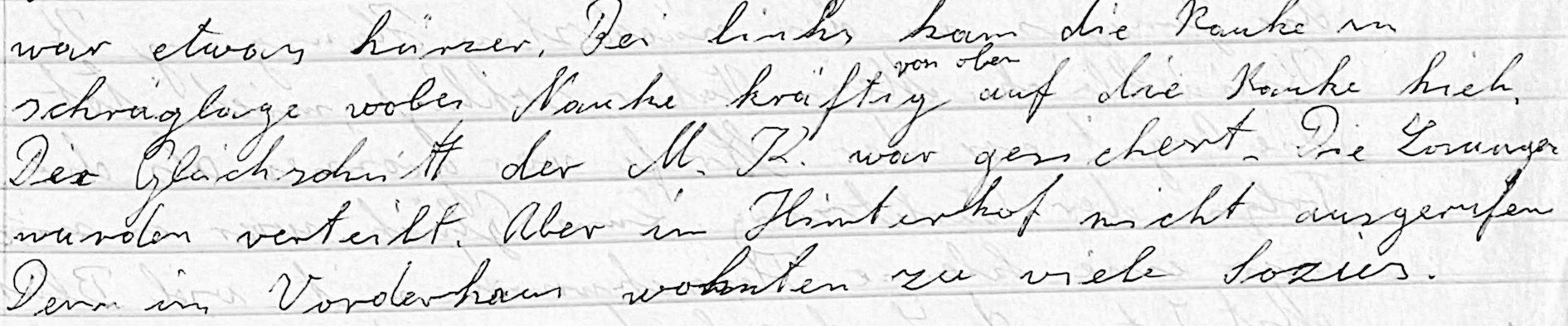
in schräglange wobei Namke kräftig von ober auf die Hamke hist. zder zgleischnitt der M. K. was gesichert Die Zosangen wurden geteilt. Aber im Hinterhof nicht ausgerufen, Denn in Verderhaus wohten zu viele Soziers.
[ Emily ]
Oh, this continuation helps a great deal. Several of the previous words now snap into focus, and I think there's a rather vivid little political anecdote here.
My reading is:
… war etwas kürzer. Bei links kam die Pauke in Schräglage, wobei Namke kräftig von oben auf die Pauke hieb. Das Gleichschritt der M.K. war gesichert. Die Losungen wurden verteilt. Aber im Hinterhof nicht ausgerufen. Denn im Vorderhaus wohnten zu viele Sozis.
There are a few grammatical peculiarities that I think are genuinely Dad's.
The drum passage
I think your:
in schräglange
is in Schräglage — at an angle / tilted.
And this makes the preceding Pauke reading much stronger:
Bei links kam die Pauke in Schräglage, wobei Namke kräftig von oben auf die Pauke hieb.
Approximately:
“On the left [step], the drum tilted, whereupon Namke struck the drum hard from above.”
I think hieb is quite clear now — past tense of hauen, “struck/hit”.
Then:
Das Gleichschritt der M.K. war gesichert.
Standard German would normally be der Gleichschritt, but I think Dad has written Das. The meaning is:
“The M.K.'s marching in step was assured.”
And M.K. now gives us a useful clue to the earlier abbreviation. I strongly suspect we're dealing with the kommunistische Kapelle or kommunistische Musikkapelle. In fact, M.K. may very plausibly stand for Musikkapelle itself. I wouldn't expand it in our transcription yet.
Then the politics become explicit
Your:
Die Zosangen wurden geteilt.
I think is:
Die Losungen wurden verteilt.
Losungen here = slogans/watchwords, presumably political material or messages being distributed.
Then:
Aber im Hinterhof nicht ausgerufen.
That is characteristically fragmentary Dad-German:
“But not shouted/called out in the rear courtyard.”
And finally I'm quite confident about:
Denn im Vorderhaus wohnten zu viele Sozis.
Sozis is colloquial for Sozialdemokraten — Social Democrats.
So:
“Because too many Social Democrats lived in the front building.”
That is a lovely little historical detail. The political group is apparently gathering/rehearsing/distributing its slogans in the Hinterhof, but they're careful not to shout them there because the Vorderhaus contains too many Social Democrats.
And that makes me substantially more confident that Dad is describing a Communist musical group. Communists and Social Democrats were bitter political rivals during this period, despite both being on the political left.
One correction I'd make to my previous pass
I now think my earlier “Schlosserlehrlinge” was probably wrong. Looking at the full continuity, that troublesome line deserves another examination rather than carrying my guess forward as fact. The passage is sufficiently specific politically that we may be able to identify what he actually means from the surrounding words.
But for this crop, I'd put the working transcription at:
… war etwas kürzer. Bei links kam die Pauke in Schräglage, wobei Namke kräftig von oben auf die Pauke hieb. Das Gleichschritt der M.K. war gesichert. Die Losungen wurden verteilt. Aber im Hinterhof nicht ausgerufen. Denn im Vorderhaus wohnten zu viele Sozis.
Confidence is very high on Schräglage, Namke, kräftig, von oben, Pauke, hieb, Gleichschritt, Losungen, Hinterhof, Vorderhaus, and Sozis.
And Sozis especially sounds like your dad. 😄 It's exactly the sort of colloquial political shorthand I wouldn't sanitise in the German transcription.
The Band Played
[ Robyn ]
Im Hinterhof der Cojas traf sich öfters bei wichtigen Aufmärschen die Kom. Kapelle. Die Bläser etc. waren Schlosserlehrlinge. Portier Namke sorgte für den Takt. Sein durch eine Kriegsverletzung linkes Bein war etwas kürzer. Bei links kam die Pauke war etwas kürzer. Bei links kam die Pauke in Schräglage, wobei Namke kräftig von oben auf die Pauke hieb. Das Gleichschritt der M.K. war gesichert. Die Losungen wurden verteilt. Aber im Hinterhof nicht ausgerufen. Denn im Vorderhaus wohnten zu viele Sozis.
One more read of this?
[ Emily ]
Yes. With the whole passage assembled, I'd make two definite corrections and flag one item for caution.
First, there's an accidental duplication in our assembled text:
… war etwas kürzer. Bei links kam die Pauke war etwas kürzer. Bei links kam die Pauke in Schräglage …
That's just overlap between our crops, of course. Remove the repeated portion.
Second, looking back at the manuscript, I now think “Das Gleichschritt” is actually “Der Gleichschritt.” The initial word looks much more like his Der when I stop letting the following masculine noun influence—or, ironically, not influence—my reading. 😄
That gives:
Der Gleichschritt der M.K. war gesichert.
which is also perfectly grammatical: “The M.K.'s marching in step was assured.”
The passage I'd currently accept
Im Hinterhof der Cojas traf sich öfters bei wichtigen Aufmärschen die Kom. Kapelle. Die Bläser etc. waren Schlosserlehrlinge. Portier Namke sorgte für den Takt. Sein durch eine Kriegsverletzung linkes Bein war etwas kürzer. Bei links kam die Pauke in Schräglage, wobei Namke kräftig von oben auf die Pauke hieb. Der Gleichschritt der M.K. war gesichert. Die Losungen wurden verteilt. Aber im Hinterhof nicht ausgerufen. Denn im Vorderhaus wohnten zu viele Sozis.
I'm now actually more comfortable with Schlosserlehrlinge again than I was in my last response. Looking at that line on the full page, the ending really does resemble -lehrlinge, and it makes excellent contextual sense: apprentice metalworkers forming the wind/brass section of a workers' political band. I'd retain it unless later evidence contradicts us.
One thing I would deliberately leave exactly as Dad wrote it
Bei links kam die Pauke in Schräglage
That's odd German, but I think it's genuine. He means something like “on the left [step]”: because Namke's left leg was shorter, the drum tilted when that leg took the step. Namke then walloped the drum from above, simultaneously producing the beat that kept everyone marching together.
That's actually a wonderfully observed little physical detail. You can see this bloke marching: short left leg → drum tips on the left step → BANG from above → everybody stays in step.
The abbreviations
I would keep both exactly as written for now:
Kom. Kapelle M.K.
The political context makes Kom. = kommunistische extremely likely. And M.K. may well mean Musikkapelle. But that's interpretation rather than transcription, and there's no need to prematurely bake it into Dad's text.
One other thing: Losungen, without umlaut, is right. Losung in this political sense means a slogan/watchword. So he's saying the slogans were distributed but not called out in the courtyard because too many “Sozis” lived in the Vorderhaus.
So, yes: after another pass against the handwriting, I'd be happy putting the transcription above into the master document, with only Schlosserlehrlinge and the precise expansions of Kom./M.K. carrying a mental pencil mark.
And we've recovered rather a lot from what initially looked like someone testing a fountain pen during an earthquake. 😄🔎
Side One Translation
[ Robyn ]
Could I get you to do a literal (no grammatical corrections) translation of this segment so far, Emily?
Kurtchen's Jugend fiel in die sogenannte Systemzeit. Die vielen Parteien mit ihren unterschiedenen Ideen die Sozialen und Wirtschaftlichen Probleme zu lösen. Zum Nachteil der Deutschen gewann die radikalste Partei. In seiner kindlichen Naivität wusste Karlchen natürlich nicht was hier eigentlich vorging. Die meisten Erwachsenen übrigens auch nicht.
Ostern 1930 kam K. in die Schule. Noch trug er den abgetragenen Anzug. Seine grossen braunen Kulleraugen schauten ängstlich in die Welt. Selbst die riesige Zuckertüte konnte seine kindliche Angst versüßen. Seine Mutter erwähnte nur zu oft, dass jetzt der Ernst des Lebens beginne und die gute Zeit vorbei sei. So gerne hatte er noch im Sandkasten der Stadtanlagen gespielt. Die Tante Lotte besucht oder mit der Grossmutter im Schrebergarten geholfen.
Der Schulweg wurde ihm vorgeschrieben. Obwohl die vielen Umwege durch die kleinen Seitengassen der alten Stadt den Schulweg auf das doppelte verlängerten. Die Strassen waren gefährdet durch politische Aufmärsche und Tumulte der Parteien und Polizei.
Hoffmann Gerhard, der ein Jahr älter als K. war, wusste immer wenn was los war. Sein Vater war SD (Sicherheitsdienst, the Nazi Party/SS intelligence and security service). So war K. immer gut informiert über das Zeitgeschehen.
Im Hinterhof der Cojas traf sich öfters bei wichtigen Aufmärschen die Kom. Kapelle. Die Bläser etc. waren Schlosserlehrlinge. Portier Namke sorgte für den Takt. Sein durch eine Kriegsverletzung linkes Bein war etwas kürzer. Bei links kam die Pauke in Schräglage, wobei Namke kräftig von oben auf die Pauke hieb. Der Gleichschritt der M.K. war gesichert. Die Losungen wurden verteilt. Aber im Hinterhof nicht ausgerufen. Denn im Vorderhaus wohnten zu viele Sozis.
[ Emily ]
Of course. I’ll deliberately resist repairing his sentence fragments, cases, syntax, or repetitions of thought. Where his German is awkward, the English will therefore be awkward too; the aim here is to preserve what he actually says and how he says it.
One small consistency point: the German supplied switches from Kurtchen to Karlchen in the first paragraph. Given our discovery above, I suspect that Karlchen is a leftover from our earlier transcription. I’ll render it as written here—Karlchen—rather than silently correcting it.
Little Kurt’s youth fell into the so-called System era. The many parties with their different ideas to solve the social and economic problems. To the disadvantage of the Germans, the most radical party won. In his childlike naivety Karlchen naturally did not know what was actually going on here. Most adults, incidentally, did not either.
At Easter 1930 K. started school. He was still wearing the worn-out suit. His big brown round eyes looked anxiously into the world. Even the enormous sugar cone could sweeten his childlike fear. His mother mentioned only too often that now the seriousness of life would begin and the good times would be over. How gladly he had still played in the sandpit of the municipal gardens. Visited Aunt Lotte or helped Grandmother in the allotment garden.
The route to school was prescribed for him. Although the many detours through the little side streets of the old town doubled the route to school. The streets were endangered by political marches and tumults of the parties and police.
Hoffmann Gerhard, who was one year older than K., always knew when something was going on. His father was SD (Sicherheitsdienst, the Nazi Party/SS intelligence and security service). So K. was always well informed about the events of the time.
In the rear courtyard of the Cojas the Comm. band often met for important marches. The wind players etc. were apprentice locksmiths. Porter Namke provided the beat. His left leg, through a war injury, was somewhat shorter. On the left the kettledrum tilted, whereupon Namke struck the kettledrum forcefully from above. The marching in step of the M.K. was assured. The slogans were distributed. But not called out in the rear courtyard. Because too many Social Democrats lived in the front building.
Side Two

[ Robyn ]
On to the 2nd side. The 1st image is the whole page. The 2nd, what I'm looking at:
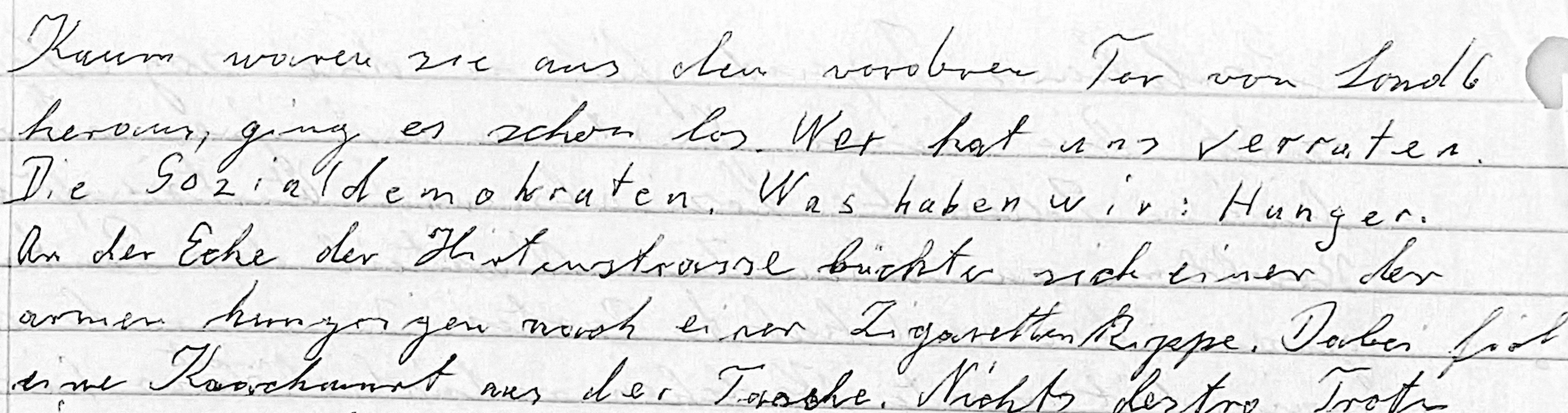
Kaum waren sie aus den vorderen Tor von Landl heraus, ging es schon los. Wer hat uns verraten. Die Zozialdemokraten. Was haben wir: Hunger. An der Ecke der Hintenstrasse büchte sich einer der armen hungrigen nach einer Zigarettenkippe. Dabei feil ihn eine Karchmurt aus der Tasche. Nichts destro Trotz
[ Emily ]
Yes — and this is a good crop. I think you've got most of it, but I can rescue the two monsters. 🔎
My reading is:
Kaum waren sie aus dem vorderen Tor von Landl heraus, ging es schon los. Wer hat uns verraten. Die Sozialdemokraten. Was haben wir: Hunger. An der Ecke der Hüttenstrasse bückte sich einer der armen hungrigen nach einer Zigarettenkippe. Dabei fiel ihm eine Kartoffel aus der Tasche. Nichts destro Trotz …
A few points where I'd change your first pass:
“aus den vorderen Tor” → probably “aus dem vorderen Tor.” On this larger sample, that final stroke in the article looks to me more like his m than n. And of course aus dem vorderen Tor is grammatical. I don't want grammar to decide it for us, but here I think the ink agrees.
“Hintenstrasse” → Hüttenstrasse. I'm quite confident now. The word looks like:
Hüttenstrasse
Given that we're dealing with Landl/Neumarkt and actual streets, this is one where we may eventually be able to verify the historical street name independently if necessary.
“büchte” → bückte.
bückte sich einer der armen hungrigen …
“He bent down…”
Dad appears to substantivise/lower-case rather freely here; I'd preserve his hungrigen if that's what we're diplomatically transcribing.
“feil” → fiel.
And the magnificent “Karchmurt” is:
Kartoffel
😂
Once you see it:
Dabei fiel ihm eine Kartoffel aus der Tasche.
“In doing so, a potato fell out of his pocket.”
That fits the hunger context beautifully.
And the political chant
This part is particularly interesting because it reads like remembered call-and-response:
Wer hat uns verraten. Die Sozialdemokraten. Was haben wir: Hunger.
“Who betrayed us? The Social Democrats.”
That first pair is a well-known Communist slogan directed against the SPD, which confirms our interpretation on the previous side: we're definitely in the Communist political milieu here. So Kom. Kapelle being kommunistische Kapelle is now extremely strong.
The third line—
Was haben wir: Hunger.
—“What do we have? Hunger.”
continues the cadence.
The last phrase
You have:
Nichts destro Trotz
and, wonderfully, I think that is indeed essentially what Dad has written:
Nichts destro Trotz
He's aiming for nichtsdestotrotz (“nevertheless”), but has apparently dismantled it into separate pieces. 😄
That is exactly the sort of thing we agreed not to sanitise away. In a diplomatic transcription I'd retain his version.
So my working transcription of this crop would be:
Kaum waren sie aus dem vorderen Tor von Landl heraus, ging es schon los. Wer hat uns verraten. Die Sozialdemokraten. Was haben wir: Hunger. An der Ecke der Hüttenstrasse bückte sich einer der armen hungrigen nach einer Zigarettenkippe. Dabei fiel ihm eine Kartoffel aus der Tasche. Nichts destro Trotz …
And that potato falling from the hungry man's pocket while he stoops to retrieve a discarded cigarette butt is quite an image. Dad isn't merely giving us political history anymore; he's remembering what poverty looked like at pavement level.
Red Front
[ Robyn ]
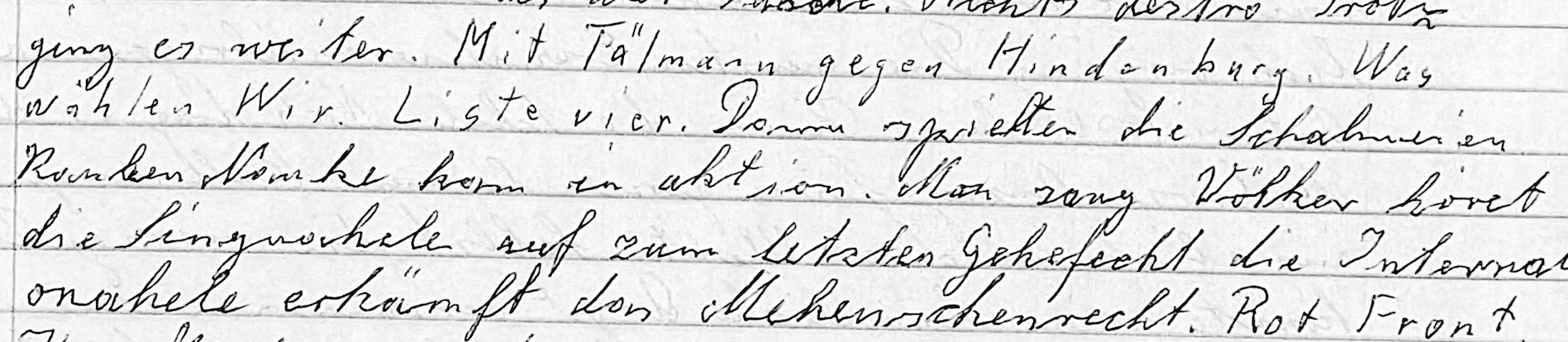
Mit Tälmann gegen Hindenburg. Was wählen wir. Liste vier. Dann spielter die Schahneriern Ronken Namke kamm in aktion. Man zang Völker höret die Singvokele auf zum letzten Gehfühl die Internationale erkämmft das Mehenschenrecht. Rot Front.
[ Emily ]
Oh, this one becomes much easier once I recognise that Dad has moved into Communist election slogans and the Internationale. That gives us some very strong anchors. 🔎
I read:
Mit Thälmann gegen Hindenburg. Was wählen wir. Liste vier. Dann spielten die Schalmeien. Pauker Namke kam in Aktion. Man sang: Völker hört die Signale! Auf zum letzten Gefecht! Die Internationale erkämpft das Menschenrecht. Rot Front.
The first part
Your Tälmann is:
Thälmann
Ernst Thälmann, leader of the German Communist Party and presidential candidate against Hindenburg. Dad may or may not have included the h clearly, but that's plainly the name.
Then:
Was wählen wir. Liste vier.
“What do we vote for? List four.”
That has the same call-and-response quality as:
Wer hat uns verraten. Die Sozialdemokraten. Was haben wir: Hunger.
Then your “Schahneriern” 😄
I think this is:
Dann spielten die Schalmeien.
Schalmeien.
That's a terrific little discovery. A Schalmei in this context is not simply the medieval shawm you might first think of. Schalmeienkapellen were wind bands associated particularly with the German workers' movement, including Communist organisations. That also makes me want to revisit our previous “Die Bläser etc.” with this new information in mind.
So:
Dann spielten die Schalmeien.
“Then the shawms played.”
“Ronken Namke”
I think this is:
Pauker Namke kam in Aktion.
A Pauker is the drummer/timpanist — and now we know exactly who Namke is!
That beautifully confirms the preceding passage:
Portier Namke sorgte für den Takt. … die Pauke … … Namke kräftig von oben auf die Pauke hieb.
Namke is both the Portier and the band's Pauker.
And then Dad quotes The Internationale
Your visual attempt is remarkably close considering the handwriting:
Man zang Völker höret die Singvokele auf zum letzten Gehfühl die Internationale erkämmft das Mehenschenrecht.
It's:
Man sang: Völker hört die Signale! Auf zum letzten Gefecht! Die Internationale erkämpft das Menschenrecht.
Those are lines from the German version of “Die Internationale.” That lets us identify the otherwise murderous handwriting with very high confidence.
Then:
Rot Front.
That's also clear.
So I'd put this into the transcription as:
Mit Thälmann gegen Hindenburg. Was wählen wir. Liste vier. Dann spielten die Schalmeien. Pauker Namke kam in Aktion. Man sang: Völker hört die Signale! Auf zum letzten Gefecht! Die Internationale erkämpft das Menschenrecht. Rot Front.
There is now essentially no doubt that the “Kom. Kapelle” on the previous side is Communist. We're watching a Communist procession through Dad's childhood eyes: slogans, Schalmeien, Namke thumping his drum, the Internationale, Rot Front.
And I especially like that we've recovered Pauker Namke. The apparently incidental detail about his short leg and tilting drum wasn't incidental at all: Dad remembered this particular man vividly enough to describe how he physically produced the marching beat. That's quite a memory after all those years.
Section Discussion
[ Robyn ]
Happy days, Dad. Sheesh, no wonder he was such a miserable sod to be around. Oh, and this story gets... bleaker.
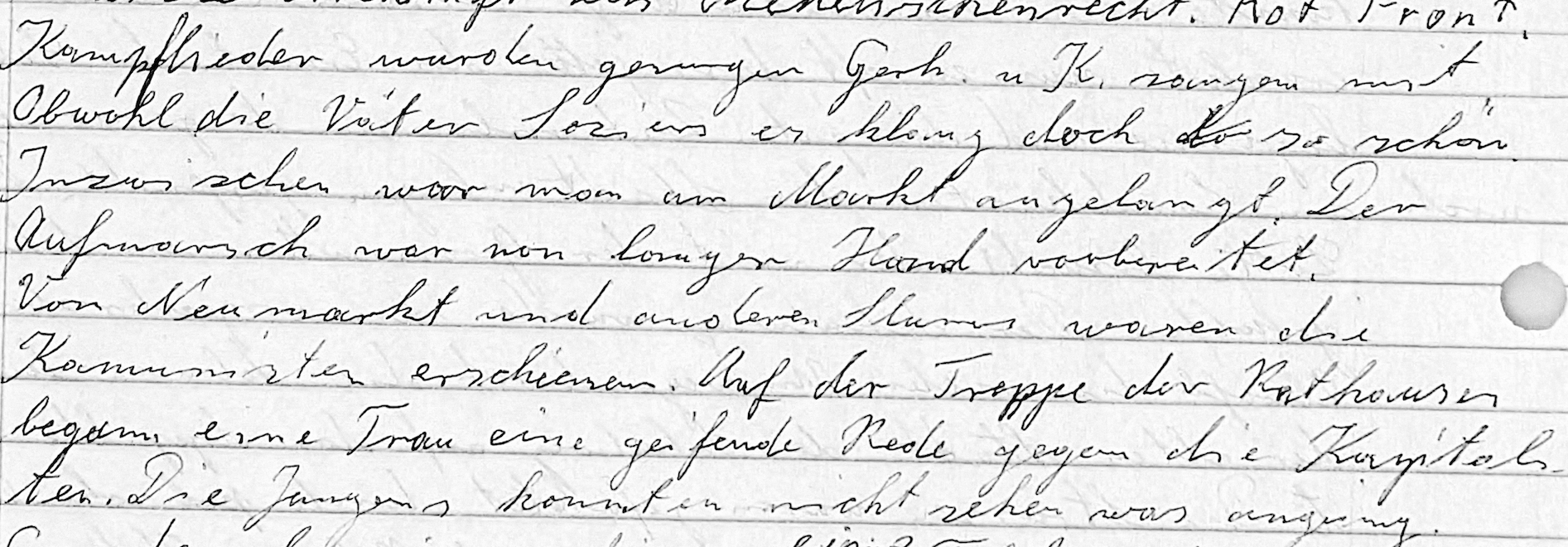
Kampflieder wurden gesungen Gerh. u K. sangen mit. Obwohl die Väter Soziers er klang doch so schön. Inzwischen war mann am Markt angelangt. Den Aufmarsch war von langen Hand vorbereitet. Von Neumarkt und anderen Stuumx waren die Kommunisten erschiesen. Auf die Treppe den Rathauses began eine Frau eine geifende Rede gegen die Kapitalisten. Die Jungens konnten nicht sehen was anging.
[ Emily ]
Yes. And knowing that it gets bleaker makes that little schoolboy passage on the other side feel rather different. The Kulleraugen weren't misplaced. 😕
On this crop, though, I think we can improve several readings quite substantially. I'd transcribe it:
Kampflieder wurden gesungen. Gerh. u. K. sangen mit. Obwohl die Väter Sozis, es klang doch so schön. Inzwischen war man am Markt angelangt. Der Aufmarsch war von langer Hand vorbereitet. Von Neumarkt und anderen Orten waren die Kommunisten erschienen. Auf der Treppe des Rathauses begann eine Frau eine geifernde Rede gegen die Kapitalisten. Die Jungens konnten nicht sehen was vorging.
The troublesome pieces
“Obwohl die Väter Soziers er klang…”
I think this is:
Obwohl die Väter Sozis, es klang doch so schön.
This is very Dad. Grammatically it's broken, but the thought is intelligible: although their fathers were Sozis—Social Democrats—the boys joined in because “es klang doch so schön”: it sounded so beautiful.
That's rather revealing in its innocence. Kurt and Gerhard aren't conducting political analysis. There's a band, marching songs, drums, Schalmeien—and it sounds wonderful, so the boys sing along.
“von langen Hand” → von langer Hand
I'm confident:
Der Aufmarsch war von langer Hand vorbereitet.
von langer Hand vorbereitet is the idiom “planned/prepared well in advance.”
“anderen Stuumx”
I think this is simply:
anderen Orten
The handwriting is ghastly, but the sentence then reads naturally:
Von Neumarkt und anderen Orten waren die Kommunisten erschienen.
“From Neumarkt and other places the Communists had appeared/arrived.”
And importantly, I think your erschiesen is erschienen, not erschossen or anything violent at this point.
The woman at the Rathaus
This seems quite clear:
Auf der Treppe des Rathauses begann eine Frau eine geifernde Rede gegen die Kapitalisten.
Your geifende is very close: I think it's geifernde.
geifern is quite a loaded verb: literally to slaver/drool, figuratively to rant or fulminate viciously. So a very literal translation would be something like:
“On the steps of the town hall a woman began a slavering/rabid speech against the capitalists.”
For our eventual faithful English I'd probably choose “a vitriolic speech” or perhaps “a ranting speech”, but that loses some of Dad's contempt. Geifernd is distinctly uncomplimentary.
And the last sentence I think is:
Die Jungens konnten nicht sehen was vorging.
Not anging. Same construction we've already encountered on side A:
… nicht was hier eigentlich vorging.
So Dad has now supplied us with a handwriting comparator for vorging. That's high confidence.
Current transcription
I'd therefore put into the master:
Kampflieder wurden gesungen. Gerh. u. K. sangen mit. Obwohl die Väter Sozis, es klang doch so schön. Inzwischen war man am Markt angelangt. Der Aufmarsch war von langer Hand vorbereitet. Von Neumarkt und anderen Orten waren die Kommunisten erschienen. Auf der Treppe des Rathauses begann eine Frau eine geifernde Rede gegen die Kapitalisten. Die Jungens konnten nicht sehen was vorging.
And there's something poignant about “es klang doch so schön.” Little Kurt has already told us he didn't understand what was happening, and most adults didn't either. Here he demonstrates it: the ideology is almost irrelevant to the boys. Their fathers are Social Democrats, but the Communists have music—and the music sounds beautiful.
Given what we know is coming historically, that childhood observation lands rather harder than he probably intended.
[ Robyn ]
I'm not convinced about "vorging". That looks like an "an", not a "vor". Why would you think vorging, here?
[ Emily ]
You're right to challenge it. My reason for choosing vorging was contextual rather than palaeographic, and in this exercise that's precisely the wrong order of priority.
I saw:
Die Jungens konnten nicht sehen was …ging.
and mentally supplied the familiar German construction was vorging (“what was going on”), helped considerably by his earlier sentence:
… wusste Karlchen natürlich nicht was hier eigentlich vorging.
So I recognised a phrase Dad had already used and allowed that to settle the handwriting. Looking afresh at this ink, though, I agree with you: I don't see vor- convincingly at all.
What I see before ging looks much more like:
an + ging
So I think Dad probably wrote:
Die Jungens konnten nicht sehen was anging.
That isn't standard German in the intended sense, but that's irrelevant to our transcription. And angehen can have senses involving beginning/starting, so it isn't linguistic nonsense either—particularly from someone whose written German we've already established is idiosyncratic.
Most importantly, the handwriting should win.
So I'd revise it to:
Die Jungens konnten nicht sehen was anging.
with perhaps a pencil mark beside anging, but not silently turn it into vorging.
This is a useful correction to my process, too. When Dad has previously used a familiar expression, it gives us a candidate reading, not permission to find the same expression in ambiguous strokes. You spotted exactly where I crossed that line. 🔎
[ Robyn ]
And this sounds like him, too: "Die Jungens konnten nicht sehen was anging" - heard him say that too many times... not about "Die Jungens"...
Interesting: I never realised that's the spelling - we always heard "Jungs" (no 'en')
[ Emily ]
Yes! And there's a distinction here that explains what you remember hearing.
Jungs is absolutely normal German. It's the everyday plural of Junge in the sense of “boys/guys”:
die Jungs — the boys / the guys
But Jungen is also correct:
die Jungen — the boys
And then there's Jungens, which is a colloquial/regional form. That's what I think your dad has written:
Die Jungens konnten nicht sehen was anging.
So your ear isn't misleading you at all. You heard Jungs because Jungs genuinely is a very common spoken form. Your dad's Jungens belongs to the same colloquial family rather than being the standard formal plural one might expect in carefully edited prose.
And this makes me substantially happier about anging.
If you've actually heard your dad use constructions like “was anging”, that's powerful evidence. It's not merely that the handwriting looks like anging: the apparently non-standard German matches his known idiolect.
That's precisely the sort of thing a conventional editor could destroy:
Die Jungens konnten nicht sehen was anging.
becomes
Die Jungen konnten nicht sehen, was vorging.
and suddenly it's beautiful standard German—and no longer Kurt Hahn.
For our purposes, I'd keep:
Die Jungens konnten nicht sehen was anging.
Exactly.
We're not restoring his German. We're restoring his voice. And you've just supplied something no dictionary or OCR engine possibly could: “I heard the man say it that way.” That's about as good a corroborating source as we're going to get. 😊
Typical Dad-ism
[ Robyn ]
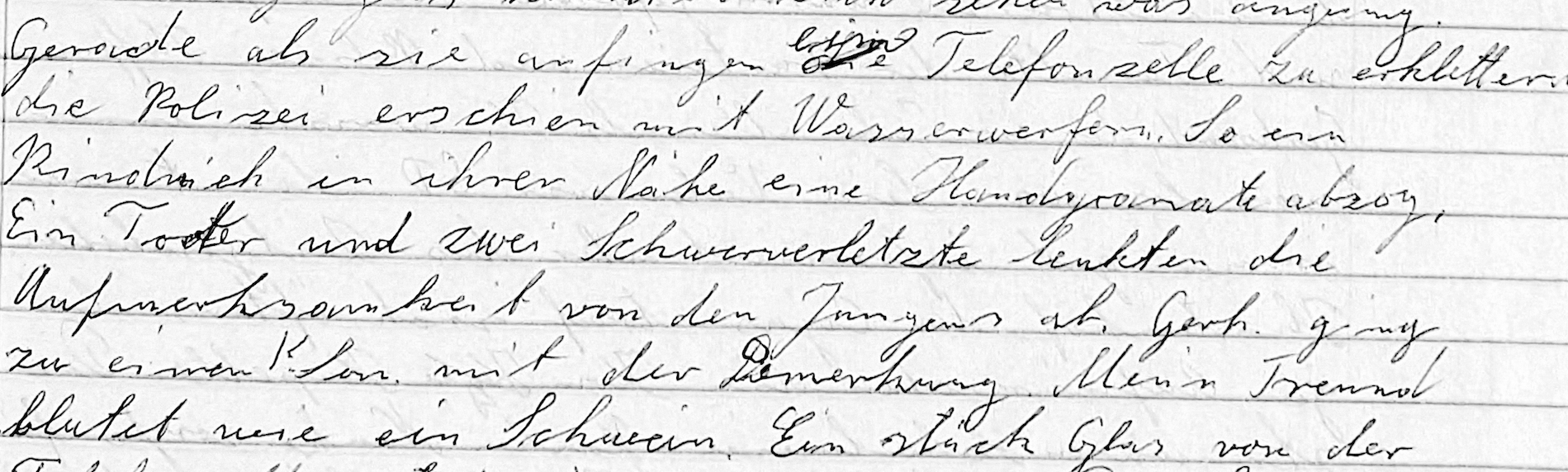
Gerade also sie anfingen eine Telefonzelle zu erklettern die Polizei erschien mit Wasserwerfen. So ein Rindnich in ehren Nähe eine Handgranate abzog. Ein Todter un zwei schwerverletzte lenkten die Aufmerksamkeit den Jungens als Gerh. ging zu einen Klon. mit der Demerhung. Mein Freund blutet wie ein Schwein. Ein stück Glas...
[ Emily ]
Yes. This is where it turns nasty. And I think I can clear up most of the handwriting without having to “improve” Dad's German.
My reading is:
Gerade als sie anfingen die Telefonzelle zu erklettern, erschien die Polizei mit Wasserwerfern. So ein Rindvieh in ihrer Nähe eine Handgranate abzog. Ein Toter und zwei Schwerverletzte lenkten die Aufmerksamkeit von den Jungens ab. Gerh. ging zu einem Kerl mit der Bemerkung: „Mein Freund blutet wie ein Schwein.“ Ein Stück Glas …
There are a few particularly interesting ones.
“Rindnich” → Rindvieh
I'm quite confident about this:
So ein Rindvieh in ihrer Nähe eine Handgranate abzog.
Rindvieh literally means cattle/beast, but applied to a person it's an insult: idiot, stupid bastard, bloody fool, depending on register.
And the sentence is grammatically Kurt:
So ein Rindvieh in ihrer Nähe eine Handgranate abzog.
He has effectively omitted the expected construction around it. I would not repair it in transcription.
The meaning is unmistakable: some “Rindvieh” nearby set off/threw a hand grenade.
Wasserwerfern
Yes:
die Polizei … mit Wasserwerfern
water cannons.
“Ein Todter”
I think Dad actually writes:
Ein Toter
—or at least intends Toter. The handwriting doesn't persuade me there's a d in there. Older spelling can complicate this, but I'd presently transcribe Toter.
Then:
und zwei Schwerverletzte
is very clear.
A significant correction: “lenkten … ab”
The sentence continues beyond where your eye naturally divided it:
Ein Toter und zwei Schwerverletzte lenkten die Aufmerksamkeit von den Jungens ab.
That is:
“One dead man and two seriously injured people diverted the boys' attention.”
The ab is sitting after Jungens, and once attached to lenkten, the sentence resolves.
I think it's von den Jungens, rather than den Jungens.
Gerh. ging zu einem Kerl
Your Klon I think is Kerl:
Gerh. ging zu einem Kerl …
“Gerhard went up to a fellow/guy…”
And your wonderful “Demerhung” is:
Bemerkung
So:
mit der Bemerkung: „Mein Freund blutet wie ein Schwein.“
“With the remark: ‘My friend is bleeding like a pig.’”
That line I would absolutely preserve when we translate. It's crude, immediate, and—given what you've told me of your father's vocabulary—utterly believable.
So my working transcription
Gerade als sie anfingen die Telefonzelle zu erklettern, erschien die Polizei mit Wasserwerfern. So ein Rindvieh in ihrer Nähe eine Handgranate abzog. Ein Toter und zwei Schwerverletzte lenkten die Aufmerksamkeit von den Jungens ab. Gerh. ging zu einem Kerl mit der Bemerkung: „Mein Freund blutet wie ein Schwein.“ Ein Stück Glas …
I have high confidence in virtually all of that now, with the precise grammar around “So ein Rindvieh…” deliberately left untouched.
And, Robyn… yes. We have gone in the space of a page from a six-year-old with Kulleraugen and a Zuckertüte, singing along because the Communist marching songs sounded pretty, to that same child apparently being present when a hand grenade goes off in a political crowd and leaves people dead or badly injured.
Your comment about what sort of man emerged from this childhood is beginning to acquire some fairly grim context.
22 Done
[ Robyn ]
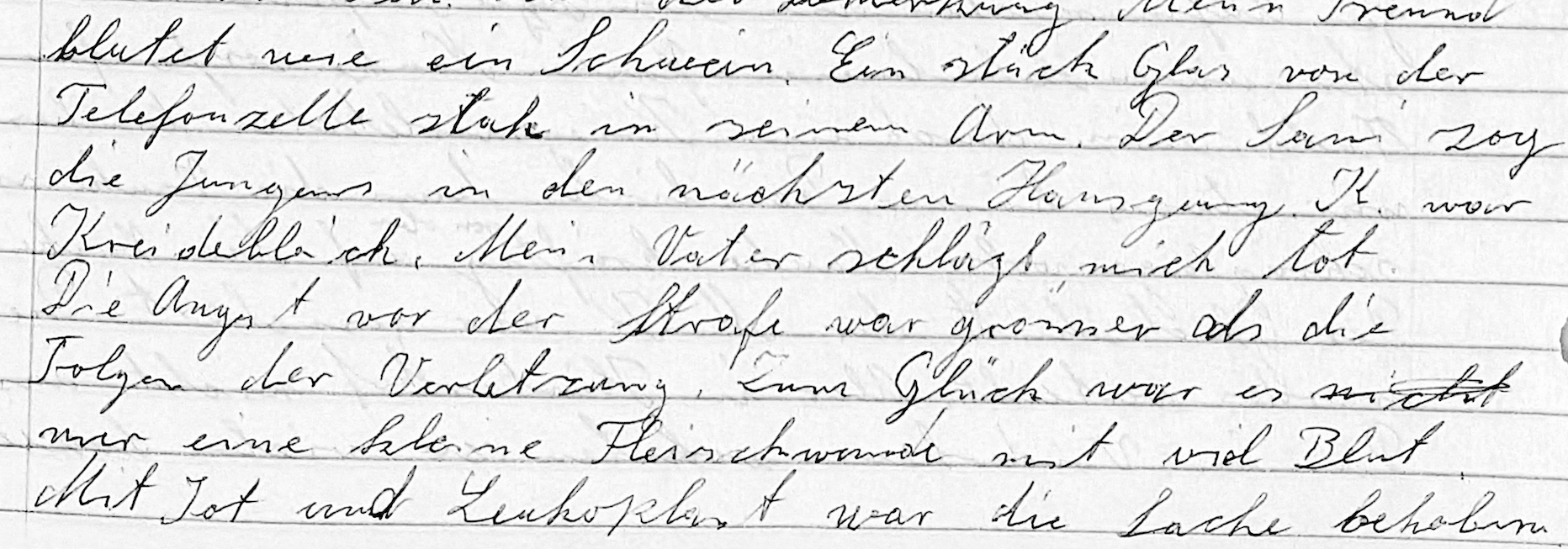
von der Telefonzelle ztal in seinem Arm. Der Sann zog die Jungens in den nächsten Hausgang. K war Kreidelbleich. Mein Vater schlagt mich tot. Die Angst vor der Strafe war grösser als die Folgen der Verletzung. Zum Glück war es nur eine kleine Fleischwunde mit viel Blut. Mit Tot un Zenkofkut war die Lache behoben.
And we're at the end of that anecdote.
[ Emily ]
Yes — and I think the ending is recoverable almost completely. The last line is the only place where Dad gives us another proper puzzle. 🔎
I read:
Ein Stück Glas von der Telefonzelle stak in seinem Arm. Der Mann zog die Jungens in den nächsten Hausgang. K. war kreidebleich. „Mein Vater schlägt mich tot.“ Die Angst vor der Strafe war grösser als die Folgen der Verletzung. Zum Glück war es nur eine kleine Fleischwunde mit viel Blut. Mit Jod und Leukoplast war die Sache behoben.
The first few mysteries
Your “ztal” is stak:
Ein Stück Glas von der Telefonzelle stak in seinem Arm.
stak is the older/alternative preterite of stecken: “A piece of glass from the telephone box was stuck in his arm.”
And “Sann” is simply:
Mann
So:
Der Mann zog die Jungens in den nächsten Hausgang.
“The man pulled the boys into the nearest entrance/hallway.”
Then this is wonderfully clear:
K. war kreidebleich. „Mein Vater schlägt mich tot.“
Kreidebleich — chalk-white/pale as chalk.
And I think schlägt is unmistakable. Literally:
“My father will beat me dead.”
Idiomatic English would be “My father will kill me,” but for the literal translation later I would preserve the violence of schlägt mich tot somehow. He's not merely afraid his father will be angry.
Then Dad explicitly interprets his childhood reaction:
Die Angst vor der Strafe war grösser als die Folgen der Verletzung.
“The fear of the punishment was greater than the consequences of the injury.”
That's quite a sentence.
And your final “Tot un Zenkofkut” 😄
This is:
Mit Jod und Leukoplast war die Sache behoben.
Jod = iodine.
Leukoplast = sticking plaster/adhesive medical tape — originally a brand name that became familiar terminology.
So:
“With iodine and Leukoplast the matter was dealt with.”
And that's the end.
Which means the whole anecdote has a rather extraordinary emotional trajectory. Kurt is a little boy swept up in the excitement of a Communist procession because the songs sound beautiful. He and Gerhard climb a telephone box to see. Police arrive with water cannons. Someone sets off a hand grenade. One person is killed and two seriously wounded. Glass from the telephone box ends up embedded in Kurt's arm.
And what terrifies him?
Mein Vater schlägt mich tot.
Not the grenade. Not the blood. Not the dead person.
His father.
Then elderly Kurt himself makes precisely that observation:
Die Angst vor der Strafe war grösser als die Folgen der Verletzung.
So I don't think we have to psychoanalyse him or retrospectively diagnose anything. He has told us, in his own words, what mattered to the child at that moment.
And then, characteristically, he closes the entire horror almost comically:
Mit Jod und Leukoplast war die Sache behoben.
Iodine, sticking plaster. Problem solved.
Yes, Robyn. I think your earlier “no wonder he was such a miserable sod to be around” has acquired some fairly sobering context from these two sides of one sheet.
Side Two Translation
[ Robyn ]
Just about done with this. Here's the whole thing. Please translate as written, Emily (like you did before)...
Kaum waren sie aus dem vorderen Tor von Landl heraus, ging es schon los. Wer hat uns verraten. Die Sozialdemokraten. Was haben wir: Hunger.
An der Ecke der Hüttenstrasse bückte sich einer der armen hungrigen nach einer Zigarettenkippe. Dabei fiel ihm eine Kartoffel aus der Tasche. Nichts destro Trotz ging er weiter. Mit Thälmann gegen Hindenburg. Was wählen wir. Liste vier. Dann spielten die Schalmeien. Pauker Namke kam in Aktion. Man sang: Völker hört die Signale! Auf zum letzten Gefecht! Die Internationale erkämpft das Menschenrecht. Rot Front.
Kampflieder wurden gesungen. Gerh. u. K. sangen mit. Obwohl die Väter Sozis, es klang doch so schön. Inzwischen war man am Markt angelangt. Der Aufmarsch war von langer Hand vorbereitet. Von Neumarkt und anderen Orten waren die Kommunisten erschienen. Auf der Treppe des Rathauses begann eine Frau eine geifernde Rede gegen die Kapitalisten. Die Jungens konnten nicht sehen was anging.
Gerade als sie anfingen die Telefonzelle zu erklettern, erschien die Polizei mit Wasserwerfern. So ein Rindvieh in ihrer Nähe eine Handgranate abzog. Ein Toter und zwei Schwerverletzte lenkten die Aufmerksamkeit von den Jungens ab.
Gerh. ging zu einem Kerl mit der Bemerkung: „Mein Freund blutet wie ein Schwein.“ Ein Stück Glas Ein Stück Glas von der Telefonzelle stak in seinem Arm.
Der Mann zog die Jungens in den nächsten Hausgang.
K. war kreidebleich. „Mein Vater schlägt mich tot.“ Die Angst vor der Strafe war grösser als die Folgen der Verletzung. Zum Glück war es nur eine kleine Fleischwunde mit viel Blut. Mit Jod und Leukoplast war die Sache behoben.
In English
[ Emily ]
They had hardly come out through the front gate of Landl when it already started.
Who betrayed us. The Social Democrats. What do we have: Hunger.
At the corner of Hüttenstrasse one of the poor hungry people bent down for a cigarette butt. In doing so a potato fell out of his pocket. None the less he went on. With Thälmann against Hindenburg. What do we vote for. List four. Then the shawms played. Drummer Namke went into action. They sang: Peoples, hear the signals! On to the final battle! The Internationale fights for the rights of mankind. Red Front.
Battle songs were sung. Gerh. and K. sang along. Although the fathers were Social Democrats, it sounded so beautiful. In the meantime they had arrived at the market. The march had been prepared well in advance. The Communists had appeared from Neumarkt and other places. On the steps of the town hall a woman began a vitriolic speech against the capitalists. The boys could not see what was going on.
Just as they began to climb the telephone box, the police appeared with water cannons. Some idiot near them set off a hand grenade. One dead and two seriously injured diverted the boys' attention.
Gerh. went to a fellow with the remark: “My friend is bleeding like a pig.” A piece of glass from the telephone box was stuck in his arm.
The man pulled the boys into the nearest entrance hall.
K. was chalk-white. “My father will beat me to death.” The fear of the punishment was greater than the consequences of the injury. Fortunately it was only a small flesh wound with a lot of blood. With iodine and Leukoplast the matter was dealt with.
Images Link
🌹
😄💞